What is ACL?
ACL is the short name for a ligament of the knee called Anterior Cruciate Ligament. Ligaments are tough chord-like structures which join the bones. These provide strength to the knee. There are four such ligaments in the knee - one on the inner side (MCL), one on the outer side (LCL), and two in the middle. The two middle ligaments cross each other, and are therefore called cruciate ligaments. Of these, the one in front is called Anterior Cruciate Ligament or ACL .
It is possible to lead a normal life despite a torn ligament provided you are willing to modify your lifestyle, which means low on physical activity and sports. If you are not confident about your knee (walking on irregular ground, running and stair climbing) then you need surgery. If you want to pursue active sports life, surgery is a must.
If you do not follow these restrictions and continue to play with a weak knee, it will lead to repeated injuries further damaging the knee. Such repeated injuries eventually lead to permanent damage to the knee. Surgery of ACL reconstruction is never an emergency, you can give it time and a trial of physiotherapy to see whether your body adapts to torn ligament. "Modify your life to fit your knee or modify your knee to fit your life" is the standard quote
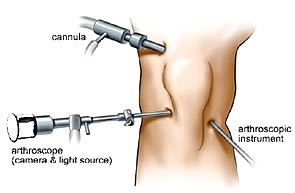
It is a standard practice these days to do ACL reconstruction, arthroscopically. The operation consists of the following steps.
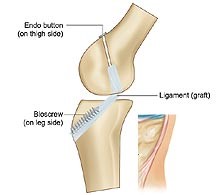
The fixation devices used are small 'button' and screws, all imported from the best companies of the world. These are self-dissolving or that of plastic, and hence do not raise alarm on metal detectors.
All this is done by key-hole surgery, without opening the knee. We use dissolvable stitches, and hence no need for stitch removal . There is minimum visible scar. The wounds are covered with water-proof dressing so that one can take bath, the very next day.
Cost may vary from case to case depending upon the technique and the implants used. These surgeries are generally covered under medical insurance. You may discuss the details when you come for fixing the date for the surgery.
The actual duration of the surgery is approximately 45 mins. to 1 hour. One needs to spend some extra time in the OT area before and after surgery.
We have standardized our technique for getting best results. Following are the salient features of our technique:
1. Fresh ACL tears: We repair where others reconstruct. This is a new concept. There are a number of cases, where a freshly torn ACL can be repaired, hence obviating the need for taking graft from the body. Repaired ligament works as good as original. We have a series of such successful cases, and have even published our technique.
2. Old ACL tears: Not all ACL tears are similar. We have developed a menu approach to ACL reconstruction, which means we make changes in our technique based on what is most suitable for the type of ACL tear in your case.
We preserve the normal tissues, and not remove them, as far as possible. We believe that the torn ligament is not useless as it does have blood supply which is so much necessary for re- vascularization of the new ligament (the graft). For this we modify our technique case to case:
We sometimes add extra-articular ligament (extra-articular reconstruction) to support the newly-constructed inside the knee ligament. This is required for patients in demanding/ athletic professions.
1. Our technique involves using Hi-tech devices (Radiofrequency prob, motorized shaver etc.), which are one time use. These make it possible to do surgery with minimal tinkering inside the knee.
2. We have an aggressive, well -coordinated, goal oriented post-operative rehabilitation programme.
Needless to say, all operations are done by the a team of specialists knee surgeons.
ACL surgery is one of the very successful operations. But, in a surgery which involves healing of tissues and creation of substitute of natural body parts, a lot depends upon a patient’s healing potential. Even in the best of hands this operation is successful in 90% of cases. There are 10% cases where the graft does not take blood supply from the body, and remains weak and sometime ruptures.
You are admitted to the hospital for one day. Some tests are conducted on you to make sure that your body is fit for anaesthesia. The operation is usually carried out under a spinal anaesthetic (an injection in your back), or sometimes under general anaesthetic.
Before undergoing surgery you may be prescribed medication. Give us a list of all medicines that you are taking or have recently taken, as there may be cross reaction between medicines.
On the day of surgery:
You may have to be fasting for 4-6 hours before surgery. The operation takes about 1 hour, but you will be in the operation theater complex for nearly 4 hours.
After the surgery, the nurses observe your recovery to make sure that your blood pressure, pulse, other vital signs, and the operated site are normal. In the recovery ward, you may have a bandage or temporary brace on your knee. You will be discharged from hospital on the day after surgery.
Recovery period:
You will be up and about with the support of a crutch on the second day after surgery. You will be using crutches for first 2 wks. You can start going to the office after 2 wks but with restricted mobility. It takes nearly 3 months of physiotherapy to feel normal in day to day activities. It might take upto 6-9 months to become fit for sports.
We have devised a protocol of physiotherapy for ACL patients in 4 phases. You will need to be under supervised physiotherapy either at our centre or with our associate physiotherapists.
We advise that you contact our physiotherapy chief immediately after your surgery for well coordinated care.
Care after surgery:
You will be advised the following:
1. Application of ice packs for 20 minutes 4 times a daily for the first few days.
2. The use of the crutches and occasionally a knee brace for a variable period.
3. Medication to relieve pain and discomfort.
4. Antibiotics to reduce the risk of infection.
Most patients will go home after 24 hours, and rest of the treatment will be at home. Depending on the type and extent of the surgery, you will be advised when you can resume your normal activities.
General Risks of Surgery:
The following is the list of possible risks of undergoing this operation. These are not to alarm you but to inform you. We take all care to keep these to the minimum, but they do occur once in a while, unfortunately.
Anaesthesia -related risks: Anaesthesia techniques have become fairly safe now, but an odd patient still runs the risk.
Surgery-related risks: The following do sometime happen.
Our philosophy: Most important, we have a philosophy of treatment. We take every patient as a human being with different requirements – physical and psychological. We customize our treatment to patient's need. Our aim is to give our patient the experience of having gone through the treatment, what we would expect for our own relative. For us, by choosing us their doctor, the patient is giving us a great honour, and we value it. To showcase that we care, all our operated patients have direct access to cell phones of our team, including that of the chief surgeon.
 Emergency No. : (+91) 74 3501 0808
For any additional inqueries :
info.precisionortho@gmail.com
Book Appointment: (+91) 74 3501 0808
Working Hourse : Mon to Sat : 4:00PM To 8:00PM
Emergency No. : (+91) 74 3501 0808
For any additional inqueries :
info.precisionortho@gmail.com
Book Appointment: (+91) 74 3501 0808
Working Hourse : Mon to Sat : 4:00PM To 8:00PM
Emergency No. : (+91) 74 3501 0808
For any additional inqueries :
info.precisionortho@gmail.com
Book Appointment: (+91) 74 3501 0808
Working Hourse : Mon to Sat : 4:00PM To 8:00PM
Emergency No. : (+91) 74 3501 0808
For any additional inqueries :
info.precisionortho@gmail.com
Book Appointment: (+91) 74 3501 0808
Working Hourse : Mon to Sat : 4:00PM To 8:00PM

 74 3501 0808
 info.precisionortho@gmail.com
 617 Maple
Trade, Sal Hospital Road, Ahmedabad
617 Maple
Trade, Sal Hospital Road, Ahmedabad